 Ankuron ACS Academy
ADRE 2.0 exam pattern: what the numbers mean for how you study
Subject weightage, negative marking and where Assam GK really fits — a plain reading of the ADRE 2.0 pattern from the official notices, and what it means for how you should study.
// current-affairs
The devastating Bhote Koshi flash flood in Nepal highlights the vulnerability of the Himalayas to cascading hazards involving landslides, avalanches, rivers and fragile infrastructure. Here is what APSC and UPSC aspirants need to know about the disaster, its geographical significance and key disaster-management lessons.
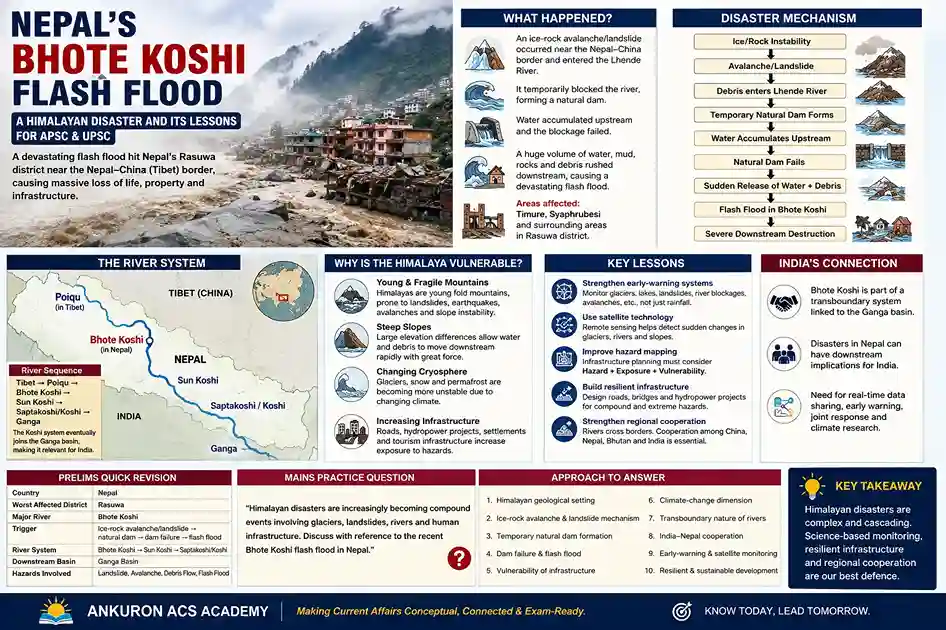
The devastating flash flood in Nepal’s Rasuwa district near the Nepal–China (Tibet) border highlights the growing vulnerability of the Himalayan region to interconnected hazards involving glaciers, landslides, avalanches, rivers and human infrastructure.
For APSC and UPSC aspirants, the event is important not simply as a current-affairs topic, but as a case study linking Himalayan geography, cryosphere, climate change, transboundary rivers and disaster management.
A sudden and destructive flood struck the Bhote Koshi River system in Nepal’s Rasuwa district, particularly affecting areas around Timure and Syaphrubesi.
The disaster originated in the high-altitude region near the Nepal–China border. An ice-rock avalanche/landslide sent a large amount of debris into the Lhende River, temporarily blocking the river channel.
The blockage acted like a natural dam. Water accumulated behind it, and when the obstruction failed, a huge volume of water, mud, rocks and debris rushed downstream into Nepal.
This produced a devastating flash flood, damaging:
The event should not automatically be classified as a Glacial Lake Outburst Flood (GLOF).
A GLOF occurs when water stored in a glacial lake is suddenly released. In the Bhote Koshi case, the immediate mechanism involved an ice-rock avalanche/landslide, river blockage and subsequent failure of the natural blockage.
This distinction is important for both APSC and UPSC Prelims and Mains.
Disaster Mechanism
This is an example of a compound or cascading disaster, where one natural hazard triggers another.
A natural dam is formed when material such as rock, soil, ice or debris blocks the course of a river.
Such a blockage can temporarily stop or slow the river, causing water to accumulate upstream.
If the blockage is suddenly breached, the stored water can be released rapidly, creating a powerful flood downstream.
Therefore, a flash flood does not always require extremely heavy rainfall at the location where flooding occurs.
The Himalayas are particularly susceptible to disasters because of the interaction of several geographical and environmental factors.
The Himalayas are a young fold mountain system formed by the collision of the Indian Plate and Eurasian Plate.
Their geological youth and active tectonic environment contribute to:
Large differences in elevation over short distances create extremely steep river valleys.
Once a natural dam breaks, water and debris can move downstream with enormous speed and destructive energy.
The Himalayan cryosphere includes:
Changes in temperature and precipitation can affect the stability of these systems and potentially increase the vulnerability of mountain environments.
Roads, bridges, hydropower projects, settlements and tourism infrastructure are increasingly being developed in narrow Himalayan valleys.
This increases the exposure of people and infrastructure to natural hazards.
The Bhote Koshi disaster also raises an important question:
Was the flood caused by climate change?
A good answer is not necessarily.
Climate change can act as a risk multiplier by influencing glacier behaviour, snow cover, permafrost stability and extreme weather patterns.
However, a particular landslide, avalanche or flood cannot automatically be attributed solely to climate change.
A better way to understand the situation is:
“Climate change may increase the vulnerability of the Himalayan system, while individual disasters result from the interaction of geological, climatic, hydrological and human factors.”
This distinction is particularly useful in UPSC and APSC Mains answers.
The Bhote Koshi is a Himalayan transboundary river associated with Nepal and Tibet.
Its upper course is known as Poiqu in Tibet. After entering Nepal, it is known as the Bhote Koshi and eventually joins the Sun Koshi.
The Sun Koshi forms part of the Saptakoshi/Koshi river system, which ultimately joins the Ganga.
Tibet → Poiqu → Bhote Koshi → Sun Koshi → Saptakoshi/Koshi → Ganga
This makes the disaster relevant to the wider Ganga basin, including downstream areas of India.
Rasuwa is located in northern Nepal, close to the Tibetan border.
Its geographical location makes it important for:
Therefore, disasters in this region can have consequences extending beyond immediate loss of life and property.
The Bhote Koshi is part of a transboundary river system, making the event relevant to India as well.
The wider Koshi river system eventually enters India and becomes part of the Ganga basin.
India also has important interests in Himalayan disaster management because hazards in Nepal can have downstream implications, particularly for areas connected to the Koshi basin.
Traditional flood-warning systems that rely primarily on rainfall monitoring may not be sufficient for high-altitude Himalayan regions.
Monitoring should include:
Remote sensing can help identify sudden changes in:
This is particularly important in remote Himalayan areas where ground-based monitoring is difficult.
Infrastructure development should be preceded by detailed assessment of:
Hazard + Exposure + Vulnerability
Development in fragile mountain environments must account for cascading hazards rather than considering floods, landslides and avalanches separately.
Roads, bridges, hydropower projects and settlements in Himalayan valleys should be designed to withstand extreme and compound hazards.
Himalayan rivers do not follow political boundaries.
Effective disaster management therefore requires cooperation among countries sharing the Himalayan river systems, particularly China, Nepal, Bhutan and India, depending on the river basin.
This single event can be connected to several areas of the civil-services syllabus.
For Assam and Northeast-focused preparation, this topic is particularly useful for understanding the relationship between Himalayan hazards, transboundary rivers and downstream flood vulnerability within the broader Brahmaputra–Ganga region.
| Topic | Key Information |
|---|---|
| Country affected | Nepal |
| Major affected district | Rasuwa |
| Major river involved | Bhote Koshi |
| Location | Nepal–China/Tibet border region |
| Immediate mechanism | Ice-rock avalanche/landslide → river blockage → sudden release |
| River system | Bhote Koshi → Sun Koshi → Saptakoshi/Koshi |
| Major downstream basin | Ganga Basin |
| Hazards involved | Landslide, avalanche, debris flow and flash flood |
| Key lesson | Need for integrated Himalayan disaster-risk management |
“Himalayan disasters are increasingly becoming compound events involving glaciers, landslides, rivers and human infrastructure. Discuss with reference to the recent Bhote Koshi flash flood in Nepal.”
Introduction:
Briefly introduce the Bhote Koshi flash flood and its location.
Body:
Conclusion:
The focus must shift from merely responding to disasters to reducing disaster risk through scientific monitoring, resilient infrastructure, ecosystem-sensitive development and stronger regional cooperation.
The Bhote Koshi flash flood is much more than a natural disaster in Nepal. It demonstrates how multiple Himalayan processes can interact and create cascading hazards.
For APSC and UPSC aspirants, the most important takeaway is not simply the location or casualty figures, but the underlying geographical process:
Himalayan geology + cryosphere instability + landslide/avalanche + natural dam + flash flood + vulnerable infrastructure + transboundary river + climate-risk multiplier
Understanding this chain allows aspirants to transform a current-affairs event into a multidimensional answer for Geography, Environment, Disaster Management and International Relations.
ANKURON ACS ACADEMY
Making Current Affairs Conceptual, Connected & Exam-Ready.
// read_next
Subject weightage, negative marking and where Assam GK really fits — a plain reading of the ADRE 2.0 pattern from the official notices, and what it means for how you should study.
State, national and international developments for the week, with the five items most likely to appear in an objective paper flagged.
// admissions_open
Weekly tests, written evaluation and a named mentor. Start with a free demo class.